

Bambu Lab P2S Review: The Better P-Series Default
Quick verdict
The Bambu Lab P2S is the better default than the P1S for a new buyer who wants a polished enclosed 256 mm printer. Its improved touchscreen, hardened extrusion path, airflow, sensing, and camera address real P1S compromises. Existing P1S owners should usually keep their machines; the P2S improves usability more than fundamental print capacity.
Research disclosure: This is a research-based buyer analysis, not a claimed JCPRINTFARM hands-on test. We checked Bambu Lab's current US listing, technical sheet, and exact-model support, then compared hands-on reporting from Tom's Hardware, PCMag, and Additive-X. Those test units do not establish fleet-wide uptime or failure rates.
What the Bambu Lab P2S is
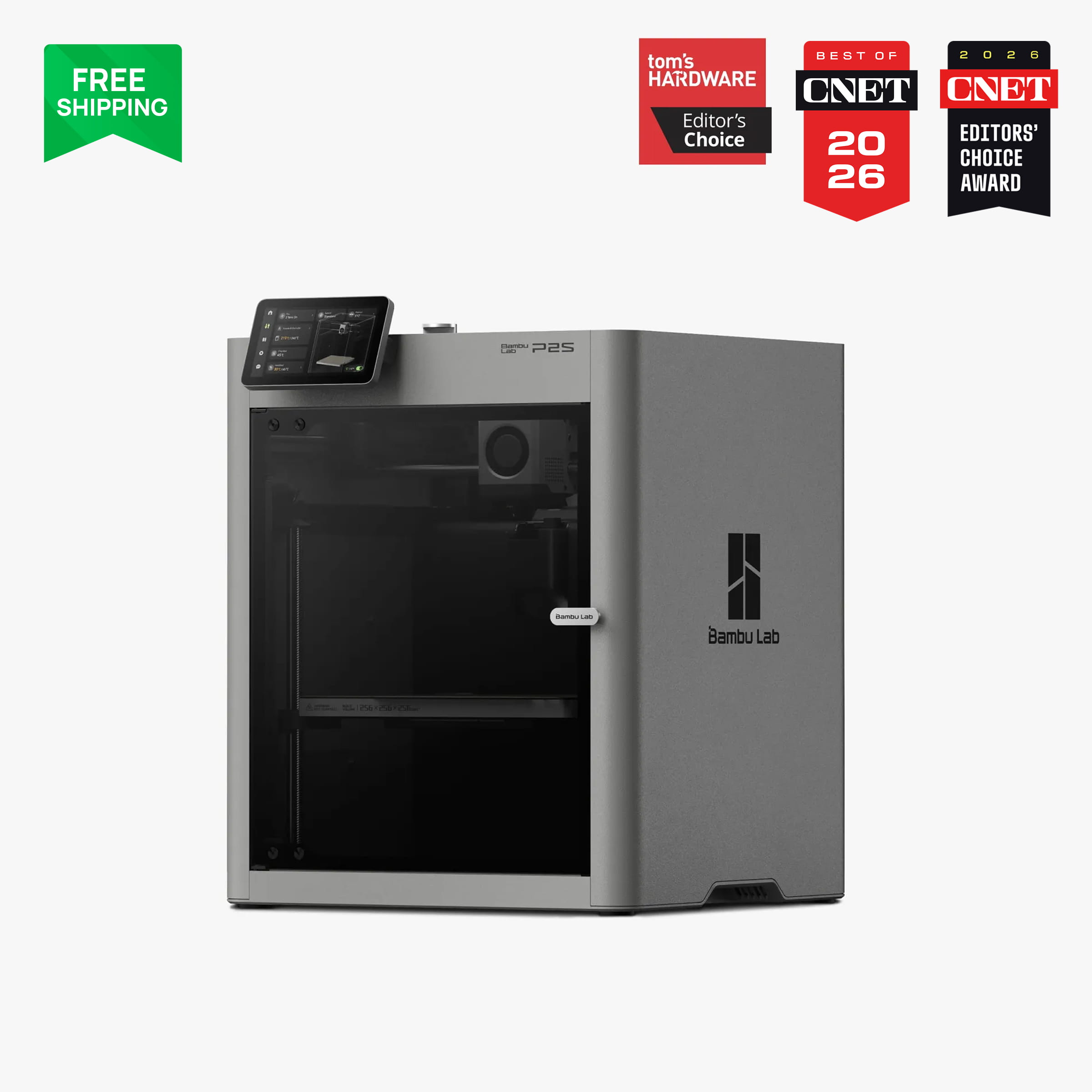
The P2S is an enclosed CoreXY FDM printer with a 256 x 256 x 256 mm build volume. It is a second-generation P-series machine, not a larger printer: the value is in a stronger everyday interface and process controls. Bambu adds a 5-inch touchscreen, 1080p/30 fps camera, hardened-steel nozzle and extruder gears, a PMSM servo extruder, automated flow calibration, improved filtration, and a cold-air intake intended to manage lower-temperature materials with the door closed.
The standalone machine feeds one spool. The Combo adds AMS 2 Pro for automated multi-spool work and filament drying. It is still a single-nozzle printer, so every color or material transition shares one melt path and may consume purge material and time.
Who it fits and who should skip it
Best fit: first-time Bambu buyers, design studios, schools, and small shops that want an enclosed 256 mm workflow for PLA, PETG, ABS, ASA, and appropriately qualified engineering materials. It is especially compelling when the better screen, camera, hardened wear path, and modern sensing reduce operator friction.
Skip it: satisfied P1S owners expecting a larger build area or a dramatic throughput jump; buyers whose parts need more than 256 mm; and color-heavy work where a multi-tool architecture can avoid repeated single-nozzle purging. An open-frame printer may also be cheaper for mostly PLA and PETG.
Key specifications in useful context
| Specification | What it means in practice |
|---|---|
| 256 x 256 x 256 mm build volume | The same useful desktop envelope as the P1S. Upgrade for workflow, sensing, and hardware refinement—not extra capacity. |
| Hardened-steel 0.4 mm nozzle and extruder gears; 300 C maximum | A better stock wear path for abrasive filled materials, but material drying, nozzle size, ventilation, and part validation still matter. |
| 110 C heatbed; enclosed chamber without active chamber heating | Appropriate for many ABS and ASA jobs after qualification. It is not equivalent to a temperature-controlled industrial chamber. |
| Up to 600 mm/s and 20,000 mm/s2; vendor 40 mm3/s maximum-flow test | Machine limits are not normal job averages. Geometry, flow, cooling, strength targets, and surface quality determine real sliced time. |
| 392 x 406 x 478 mm; 15 kg | Compact, but Bambu recommends roughly 500 x 500 x 950 mm of operating space. Allow door, rear-spool, cable, AMS, and service clearance. |
| 1080p 30 fps camera, 5-inch touchscreen, 8 GB storage and USB | A major usability upgrade over the P1S control panel and camera, especially for setup, monitoring, and local file handling. |
Where the P2S looks strongest
The P1S pain points received practical attention
The P2S keeps the successful enclosed CoreXY format while replacing the P1S's minimal screen and low-frame-rate camera. Tom's Hardware emphasized the touchscreen, USB port, and airflow refresh; PCMag praised the mature hardware-software experience; Additive-X highlighted changes to extrusion, cooling, and user interaction. These are not glamorous upgrades, but operators touch them on nearly every job.
The stock material path is more capable
Hardened-steel gears and nozzle reduce the need for an immediate wear-path upgrade when qualifying carbon- or glass-fiber-filled filaments. Bambu's supported-material list is broad, but “supported” is not a guarantee of strength, dimensions, emissions control, or stable long-run output. Record moisture, plate, nozzle, orientation, chamber conditions, shrinkage, and accepted-part results.
The enclosure is easier to live with for PLA
Bambu's cold-air cooling design draws cooler air toward the toolhead so lower-temperature materials can be run with the door closed. That can reduce the open-door ritual common on enclosed machines, but it does not repeal material-specific cooling limits. Validate bridges, overhangs, heat creep, and surface finish on representative jobs.
Limitations and workflow costs
It is still a 256 mm single-nozzle platform
No screen or sensor changes the build envelope. Large housings may still require splitting and assembly. AMS printing also needs unload, load, purge, and prime operations through one nozzle; slice representative color files and inspect model mass, purge mass, and transition time before buying the Combo.
The P1S can remain the better value
A discounted P1S reaches the same build volume and can produce similar accepted parts when properly maintained and profiled. The P2S makes the strongest case for a new purchase, not a blanket replacement campaign. Read our Bambu Lab P1S review and compare current regional prices, required wear upgrades, operator time, and expected service life.
Automation does not remove qualification
Flow calibration, filament monitoring, camera inspection, and nozzle-clumping detection are useful guardrails. They cannot certify dimensions, layer adhesion, surface finish, or safe unattended operation. Independent reviews are encouraging, but a few test units cannot predict a production fleet's failure distribution.
Realistic alternatives
Bambu Lab P1S: choose the older machine when the discount materially outweighs the P2S interface, camera, sensing, airflow, and hardened-path improvements.
Bambu Lab A1: consider the open bed slinger for lower-cost PLA and PETG work that does not need an enclosure.
Bambu Lab H2S: move up when recurring parts exceed 256 mm or actively heated chamber capability solves a verified material problem. Do not buy extra volume on speculation.
Other enclosed CoreXY printers: compare repair access, local controls, slicer dependence, spare availability, noise, dimensional results, and total workflow cost rather than headline speed alone. Our Bambu Lab production comparison provides broader lineup context.
Outsourcing: sensible when demand is sporadic or the process is not stable. Send representative files through JCPRINTFARM's project intake and compare quoted accepted parts with machine, material, labor, waste, maintenance, and floor-space costs.
Buying checklist
- Confirm every recurring part fits inside 256 x 256 x 256 mm with required brims and supports.
- Slice ten representative files and record complete time, model mass, purge mass, and operator touches.
- Compare the standalone and Combo bundles; do not value AMS 2 Pro unless multi-spool work is recurring.
- Verify current regional price, stock, voltage, warranty, returns, and bundle contents.
- Plan door, rear-spool, cable, ventilation, AMS, dryer, and maintenance clearance.
- Qualify abrasive and engineering materials for moisture, emissions, nozzle wear, shrinkage, strength, and dimensions.
- Document network, local-file, firmware, power-loss, jam, and failed-print recovery.
Lifecycle and availability in September 2026
The P2S is a current shipping product, not an announcement-only preview. On September 12, 2026, Bambu Lab's official US store marked both the standalone P2S and P2S Combo in stock at $549 and $749. Prices, promotions, gifts, inventory, and regional terms can change.
Official exact-model specifications and support are live, and multiple established outlets have published hands-on reviews. That supports a defensible buyer analysis, but not claims about long-term fleet uptime.
Final verdict
The P2S is the P-series machine most new buyers should price first. It preserves the P1S's useful size and enclosed format while addressing its weakest daily interfaces and adding a more capable stock extrusion path.
Existing P1S owners should resist upgrading for novelty: keep productive machines unless camera quality, local controls, abrasive-material setup, or operator friction has a measurable cost. If ownership is premature, JCPRINTFARM's production 3D printing service can establish demand first. Browse the verified 3D printer review hub for more exact-model comparisons.