

Bambu Lab P1S Review: Enclosed Value in 2026
Quick verdict
The Bambu Lab P1S remains a strong value when you want a proven 256 mm enclosed CoreXY printer for PLA, PETG, ABS, and ASA without paying for premium sensors or a large-format chassis. Its weak screen, modest camera, single-nozzle AMS waste, and newer P2S competition matter, but a substantial discount can keep the P1S compelling for practical single-material work.
Research disclosure: This is a research-based buyer analysis, not a new JCPRINTFARM hands-on test. We verified Bambu Lab's current US listing and technical documentation, reviewed hands-on reporting from Tom's Hardware and Tech Advisor, and checked JCPRINTFARM's separately published P1S fleet reliability notes. Third-party samples and our fleet notes do not establish a universal failure rate.
What the Bambu Lab P1S is
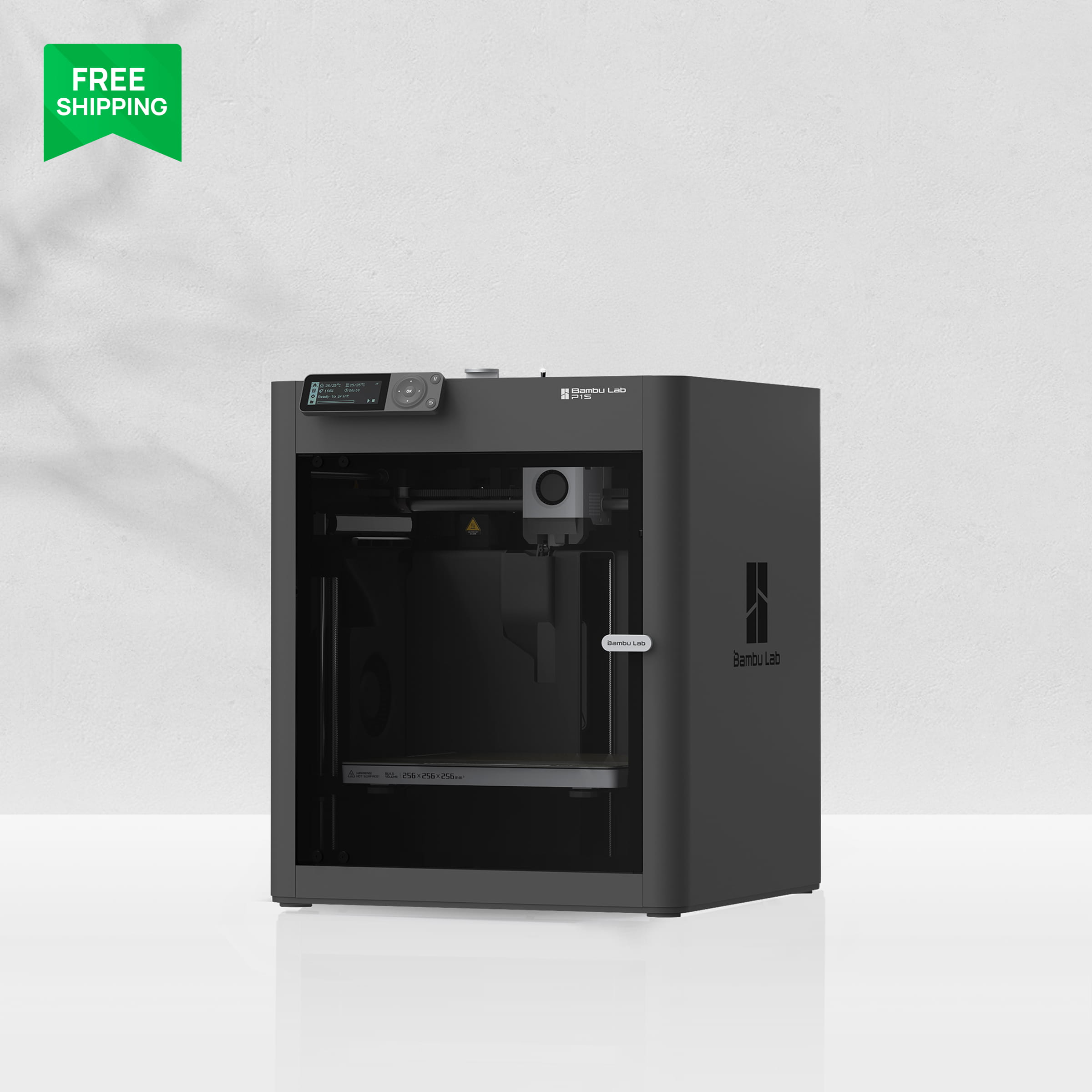
The P1S is an enclosed CoreXY FDM printer with a 256 x 256 x 256 mm nominal build volume, a 300 C all-metal hotend, a 100 C bed, automatic bed leveling, vibration compensation, a direct-drive extruder, and compatibility with Bambu's Automatic Material System. It launched as the enclosed, better-cooled counterpart to the P1P and remains the budget-focused enclosed model in Bambu's catalog.
The design is now mature rather than new. That cuts both ways: the P1S has a deep installed base, abundant documentation, and well-understood maintenance paths, while the newer P2S provides the more modern comparison point. The P1S should therefore be judged on price and job fit, not on whether it is the latest release.
Who it fits and who should skip it
Best fit: hobbyists, small shops, schools with appropriate supervision, and farms producing ordinary desktop-size parts in PLA, PETG, ABS, or ASA. It is especially sensible when most jobs are single-color and the enclosure solves a real draft, temperature, or material constraint.
Skip it: buyers who need parts larger than 256 mm, automatic flow calibration and a modern touchscreen as core requirements, frequent high-transition color work, or abrasive composites without budgeting for the correct hardened extruder and hotend components. Occasional PLA users may get better value from an open-frame machine.
Key specifications in useful context
| Specification | What it means in practice |
|---|---|
| 256 x 256 x 256 mm nominal build volume | Covers many brackets, housings, fixtures, organizers, and batch plates. Bambu notes that default printable height is 250 mm and that the filament cutter can reserve part of the area unless its documented full-volume procedure is followed. |
| Enclosed CoreXY; 389 x 389 x 458 mm chassis | More compact than a moving-bed printer with similar volume and better protected from room drafts. Leave clearance behind the machine for the spool, purge chute, wiring, and service access. |
| 300 C hotend and 100 C bed | Strong hardware for mainstream thermoplastics and enclosed ABS/ASA work. It is not an actively heated chamber, and material suitability still depends on drying, ventilation, adhesion, geometry, and process qualification. |
| 0.4 mm stainless-steel nozzle included; 0.2, 0.6, and 0.8 mm options | The stock path fits common non-abrasive materials. Bambu advises upgrading the extruder and hotend before directly printing fiber-reinforced filament. |
| Up to 500 mm/s toolhead speed and 20 m/s² acceleration claims | These are machine limits, not normal job averages. Flow, geometry, minimum layer time, strength targets, surface finish, and acceleration distance control real sliced time. |
| 720p camera at 0.5 fps | Useful for basic remote checking and time-lapse capture, but not a smooth monitoring feed or equivalent to the X1-series sensing stack. |
Where the P1S is strongest
A mature enclosed workflow at a lower price
The P1S packages automatic leveling, vibration compensation, fast CoreXY motion, enclosure, filtration, and a well-developed slicer ecosystem into one compact machine. Tom's Hardware praised its first-layer system, speed, and broad material reach. Tech Advisor likewise reported excellent print quality and fast output from its review unit.
The mature design also means maintenance questions are no longer mysterious. JCPRINTFARM's P1S maintenance checklist covers the practical schedule for cleaning, lubrication, cutters, wipers, PTFE routing, fans, and wear items. That documentation depth is valuable when the machine is equipment rather than entertainment.
The enclosure has real material value
An enclosure reduces drafts and slows heat loss, which can improve the odds of useful ABS and ASA output compared with an open bed slinger. It also contains moving parts and some debris. The activated-carbon filter is a consumable and not a substitute for a ventilation assessment; emissions, room occupancy, local rules, and the actual polymer still matter.
Single-material production avoids the worst AMS penalty
For repetitive parts from one spool, the P1S can run without the unload-load-purge cycle that makes decorative multicolor jobs expensive. An AMS can still be useful for automatic spool rollover, selecting stocked colors, and support-interface experiments, but its value should be measured against purge mass, transition time, added hardware, and operator touches.
Limitations and workflow costs
The interface and monitoring are dated
The monochrome button panel is functional but sparse. Tech Advisor called it the machine's weakest feature and also noted that the camera does not provide the failed-print detection available on higher-tier machines. Most operators will manage files through Bambu Studio or the mobile app, which makes network and account policy part of the buying decision.
AMS color changes waste time and filament
The P1S has one melt zone. Every transition must displace the previous color or material, often producing purge coils and a prime tower. Tech Advisor's testing found that frequent changes could add substantial waste and elapsed time. Slice representative files before assuming a four-spool input is the cheapest way to make a multicolor part.
Engineering materials need more than a temperature number
The enclosure and 300 C hotend broaden the material list, but there is no actively heated chamber. Large warp-prone parts can still lift or distort. Abrasive glass- or carbon-filled materials require the appropriate hardened wear path, and every production material needs documented moisture, nozzle, plate, orientation, ventilation, dimensional, and strength controls.
Integrated convenience changes the ownership model
Bambu's connected hardware, slicer, app, cloud options, RFID filament features, and proprietary replacement ecosystem reduce friction for many buyers. They also create more platform dependence than a highly open printer. Review LAN-only workflows, firmware policy, spare availability, data requirements, and downtime procedures before standardizing a fleet.
Realistic alternatives
Bambu Lab P2S: compare the successor when its improved interface, sensing, airflow, and current-generation platform are worth the price difference. If a discounted P1S and P2S are close in total cost, the newer machine deserves the default first look.
Bambu Lab A1: save money when PLA, PETG, and ordinary open-frame work dominate. The Bambu Lab A1 review explains why an easy bed slinger can be the more rational purchase when enclosure-sensitive materials are rare.
Bambu Lab H2S: step up when representative parts repeatedly exceed 256 mm or an actively heated chamber changes material qualification. Read the H2S review, then account for the larger footprint, capital, and concentrated job risk.
Other enclosed CoreXY printers: compare current Creality, QIDI, Flashforge, Anycubic, and Prusa options on complete sliced time, accepted-part quality, chamber behavior, consumable cost, network policy, and local support. Use JCPRINTFARM's Bambu production-printer comparison for same-brand context.
Outsourcing: makes sense when demand is sporadic, qualification is uncertain, or finished parts matter more than machine ownership. Send representative files through the project intake and compare the quote with machine, material, labor, waste, maintenance, and floor-space costs.
Lifecycle and availability in September 2026
The P1S is an older current-sale model, not a discontinued used-only printer. On September 11, 2026, Bambu's official US store marked the standalone P1S, P1S AMS Combo, and P1S AMS 2 Pro Combo in stock at $399, $499, and $579 respectively. Those were live promotional prices and can change without notice.
The newer P2S changes the value calculation, but it does not erase the P1S. A large discount can make the mature machine attractive for standardized single-material work, especially when an existing shop already stocks P1-series spares and has validated profiles. A first-time buyer should compare total configured prices, not old launch MSRPs.
Buying checklist
- Measure the largest recurring parts and confirm the 256 mm class avoids real splits or assembly.
- Slice ten representative jobs at accepted quality; record time, model mass, purge mass, and operator touches.
- Compare the exact P1S bundle with the current P2S and verify regional stock, warranty, and returns.
- Decide whether AMS value comes from color, spool rollover, inventory convenience, or not at all.
- Price hardened wear parts before abrasive filament and stock cutters, wipers, PTFE, hotends, and filters.
- Plan ventilation and document profiles for every ABS, ASA, PC, PA, or composite job.
- Test account, network, firmware, power-loss, jam, and failed-print recovery policies.
- For production, compare accepted parts per machine-hour rather than peak speed or parts per plate.
Final verdict
The Bambu Lab P1S is still worth buying when the price is meaningfully below newer enclosed competitors and the job is ordinary 256 mm-class, mostly single-material production. Its enclosure, mature ecosystem, speed, and compact footprint remain useful; its screen, camera, single-nozzle color workflow, and non-heated chamber are now clear compromises rather than surprises.
Buy the P1S for a measured workflow, not because it was once the obvious recommendation. Compare the actual P2S price, cost the AMS purge bill, and qualify your materials. If you need finished parts instead of another printer to manage, use JCPRINTFARM's production 3D printing service. Browse the verified 3D printer review hub for more exact-model analysis.