

Creality Hi Review: Good Value, Real Multicolor Costs
Quick verdict
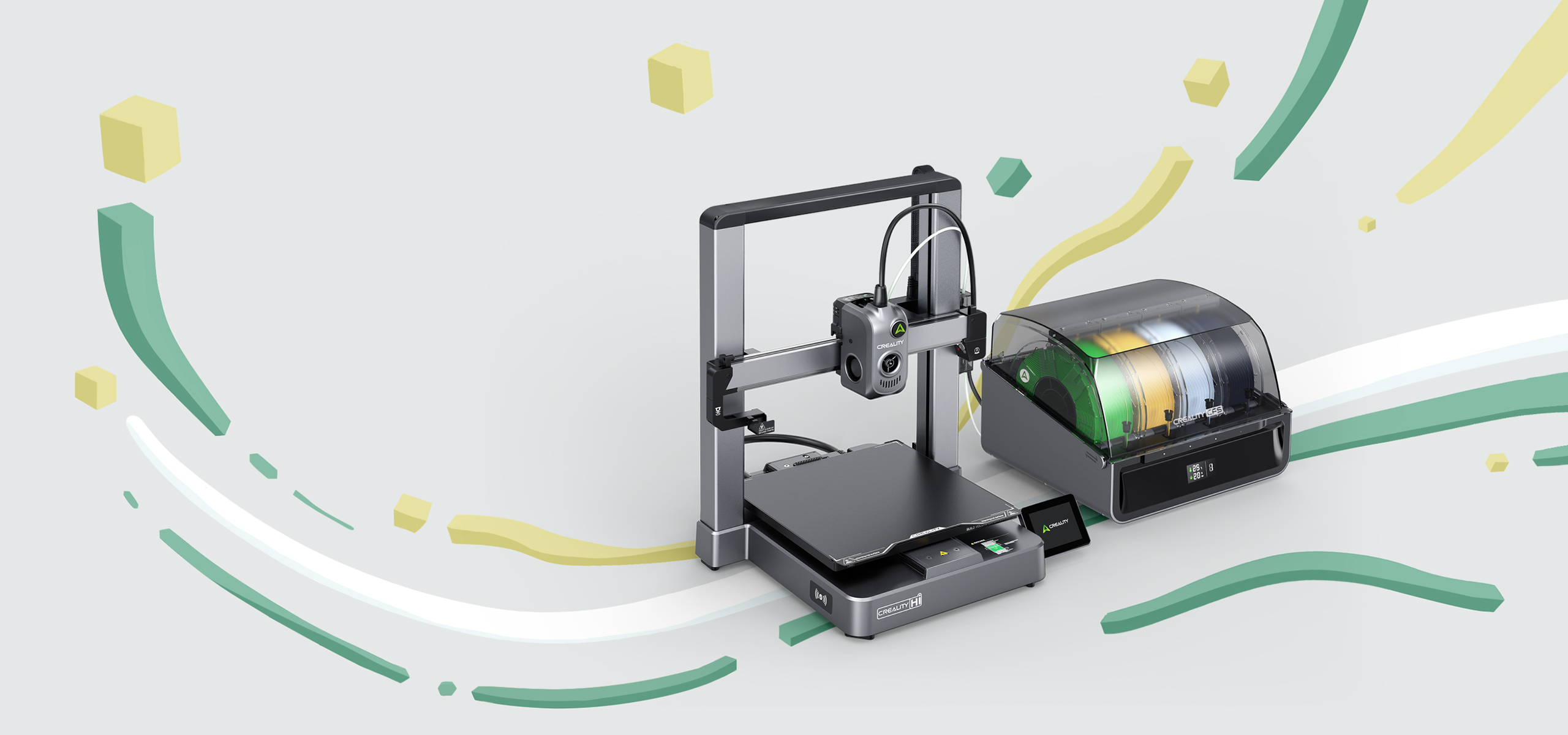
The Creality Hi is a sturdy, approachable 260 x 260 x 300 mm bed slinger that makes the most sense for value-focused PLA and PETG work. The CFS adds useful four-color and automatic-refill capability, but it also adds purge waste, time, footprint, and material restrictions. Buy the base printer for capable open-frame printing, or the Combo only when recurring multicolor jobs justify the extra workflow.
Research disclosure: This is a research-based buyer analysis, not a claimed JCPRINTFARM hands-on test. We checked Creality's current product, store, support, and TPU guidance, then compared hands-on reporting from Tom's Hardware, TechRadar, and 3DWithUs. Those test units do not establish fleet-wide reliability or failure rates.
What the Creality Hi is
The Hi is an open-frame Cartesian FDM printer with a moving 260 mm bed and 300 mm of Z height. It uses a mostly metal chassis, dual motorized Z screws, automatic leveling, input shaping, a direct-drive extruder, a quick-swap hardened-steel-tipped nozzle, a fold-out color screen, and an integrated camera. The base model prints from one spool; the Hi Combo adds one four-spool CFS.
Creality advertises expansion to four CFS units and as many as 16 filament inputs. That is capacity, not simultaneous extrusion: every color still shares one nozzle. More inputs mean more tubing, floor space, purge transitions, spool management, and possible interruption points.
Who it fits and who should skip it
Best fit: beginners and value-conscious shops producing PLA or PETG parts that fit a 260 x 260 x 300 mm envelope; creators who need occasional four-color signs, models, labels, or automatic spool refill; and operators willing to tune purge and maintain an open bed-slinger.
Skip it: buyers who need an enclosure for repeatable ABS, ASA, nylon, or polycarbonate work; users whose main workflow is soft TPU; production teams expecting headline speed on tall parts; and anyone choosing 16-color expansion without first measuring the cost of four-color jobs. An enclosed CoreXY machine is the more defensible path for controlled engineering-material work.
Key specifications in useful context
| Specification | What it means in practice |
|---|---|
| 260 x 260 x 300 mm build volume | Slightly more area and useful extra height than many 256 mm desktop printers. The moving bed still needs front-and-rear clearance. |
| Up to 500 mm/s; 12,000 mm/s² | These are upper limits, not a promise for every wall, filament, or tall part. Creality and reviewers describe roughly 300 mm/s as a more typical operating figure. |
| 300 C nozzle; 100 C bed | A broad hotend range, but the open frame and material feed path matter as much as temperature. Qualify every exact polymer and geometry. |
| 0.4 mm quick-swap nozzle; 0.6 and 0.8 mm options | The stock size balances detail and flow. Larger nozzles can shorten big-part jobs but change detail, profile, and purge behavior. |
| One to four CFS units; four to 16 inputs | Useful for color choice and refill, while every transition still consumes time and filament through one melt path. |
| Camera, Wi-Fi, USB, automatic leveling | Convenient setup and monitoring features. Test local-file, network, privacy, and outage procedures before production use. |
Where the Creality Hi looks strongest
Rigid hardware at an accessible level
The die-cast metal base and tidied gantry give the Hi a more finished structure than many entry-level bed slingers. Tom's Hardware and TechRadar both praised the build and setup, while 3DWithUs reported printing within about ten minutes after assembly and checks. That is encouraging usability evidence, not a guarantee that every shipped unit will arrive perfectly aligned.
A practical 260 mm square plate
The build area is large enough for ordinary functional parts, medium props, signs, fixtures, and dense small-part plates without entering oversized-printer territory. The 300 mm height is useful, though tall narrow parts still move with the bed. Use conservative acceleration, strong adhesion, and geometry-aware orientation when height increases leverage.
CFS can earn its place without decorative color
The best operational uses are not always rainbow prints. Automatic refill can continue compatible filament when one spool empties, and four loaded materials can reduce manual swaps between qualified jobs. RFID recognition works with supported tagged spools, while third-party filament can still be entered and used manually.
Multicolor costs are the central tradeoff
The CFS feeds several filaments through one nozzle, so each color change must retract, cut, load, and purge the previous polymer. That creates discarded filament and extends elapsed time. Tom's Hardware called the system wasteful in multicolor use. In one documented 3DWithUs multicolor project, waste approached half of total printed material before further purge tuning.
That one project should not be treated as a universal waste rate: geometry, transition count, color contrast, purge volumes, layer height, and whether purge is redirected into another part all matter. The right buying test is to slice representative files. Record model mass, purge mass, tower or shield mass, elapsed time, operator touches, and accepted-part yield for one color and four colors.
Sixteen inputs multiply selection, not nozzle count. Before adding CFS units, prove that four loaded spools save enough labor or enable enough saleable output to cover hardware, dry storage, bench space, tubing, and troubleshooting.
Material fit and TPU limits
PLA and PETG are the natural lane for this open machine, and independent reviewers reported good results with both. A 300 C nozzle and hardened tip do not turn an open bed slinger into a controlled engineering-material platform. Large ABS or ASA parts can warp without chamber control; abrasive composites accelerate wear elsewhere in the feed path; and emissions still require material-appropriate ventilation.
TPU needs special care. Creality's exact-model support guidance says flexible filaments are not suitable for CFS feeding because they can bend during loading and retraction. It also excludes softer TPU grades from the Hi and provides a narrower direct-feed procedure for compatible stiffer material. If flexible parts matter, verify the exact Shore hardness and official procedure before purchase rather than assuming “direct drive” means universal TPU support.
Workflow and ownership costs
- A moving bed needs a deeper work surface than the chassis dimensions suggest and can challenge tall, narrow jobs.
- The open frame limits temperature stability and puts hot and moving parts in the surrounding workspace.
- The CFS is dry storage with desiccant and humidity monitoring, not an actively heated dryer.
- Color changes need a purge container and routine cleanup near the printer.
- Quick-swap nozzles simplify service, but farms still need qualified spares, profiles, plates, cutters, PTFE, and wear parts.
- Cloud and camera convenience should be matched with tested USB or local procedures and clear privacy choices.
Realistic alternatives
Anycubic Kobra X: choose it when included four-input multicolor is the priority and compare its shorter-path ACE Gen 2 approach, purge behavior, software, and current price. Read our Anycubic Kobra X review.
Bambu Lab A1: compare it when polished automation and AMS Lite workflow matter more than the Hi's extra Z height or enclosed CFS storage. Our Bambu Lab A1 review covers its strengths, open-frame limits, and 2026 context.
Bambu Lab P1S: an enclosed alternative for buyers who need better environmental control and a CoreXY footprint, while accepting a 256 mm cube and single-nozzle AMS waste. See our Bambu Lab P1S review.
Outsourcing: sensible when multicolor or larger-part demand is sporadic. Submit representative files through JCPRINTFARM's project intake and compare accepted-part cost with equipment, waste, labor, spares, space, and ventilation.
Buying checklist
- Measure representative parts and include moving-bed clearance, not only nominal volume.
- Slice actual multicolor files and compare model mass, discarded purge, and elapsed time.
- Verify each filament's CFS compatibility, spool dimensions, and moisture needs.
- For TPU, confirm Shore hardness and the current exact-model direct-feed instructions.
- Test USB, network, camera, firmware, and outage recovery against shop requirements.
- Check current regional stock, warranty, returns, bundle contents, and replacement-part supply.
Lifecycle and availability in September 2026
The Creality Hi remains a supported model with a live official product page, user guide, troubleshooting articles, parts resources, and firmware ecosystem. However, on September 13, 2026, Creality's official US store showed the base Hi, Hi Combo, and two-printer option as sold out. The page displayed promotional reference prices of $299 for the base printer and $399 for the Combo, but a sold-out price is not a current purchase offer. Retailer stock, bundles, and regional terms can differ and should be verified at checkout.
This makes the Hi a current-support but stock-sensitive purchase rather than a safe assumption of direct availability. Do not pay a scarcity premium without comparing newer open multicolor printers and confirming warranty coverage.
Final verdict
The Creality Hi is strongest as a well-built, moderately roomy, easy-to-start open printer. For mostly single-color PLA and PETG, the base model avoids CFS complexity. For recurring four-color work or automatic refill, the Combo can be useful after sliced job economics prove it.
The weak buying logic is “up to 16 colors” by itself. Shared-nozzle transitions, purge, CFS restrictions, and open-frame material limits define the real machine. Buy it for measured parts and a qualified material workflow; otherwise compare a simpler printer or an enclosed alternative. JCPRINTFARM's production 3D printing service can help validate demand before hardware ownership, and the 3D printer review hub has more exact-model comparisons.