

Bambu Lab X2D Review: Dual Nozzles With a Catch
Quick verdict
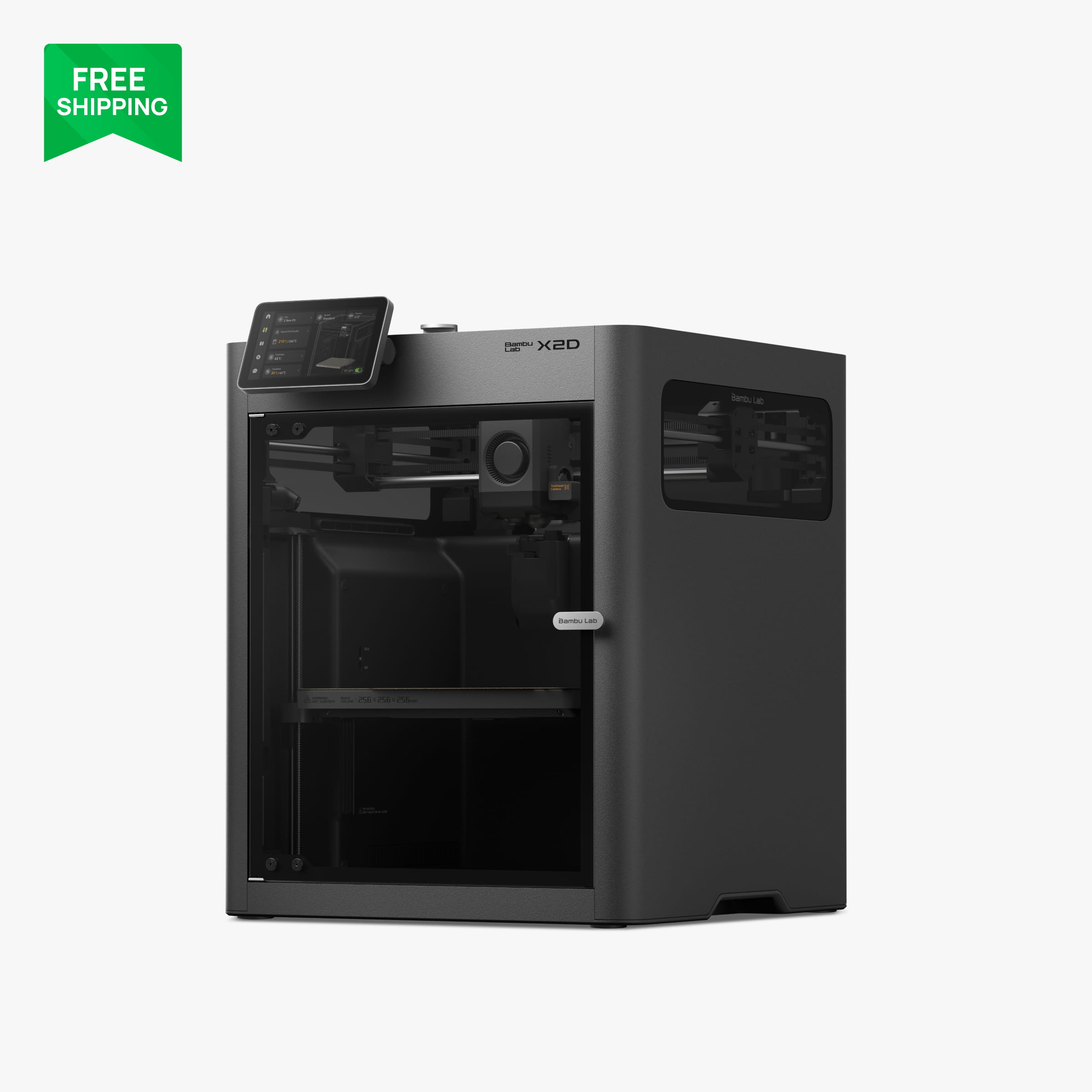
The Bambu Lab X2D is a compelling enclosed 256 mm printer for buyers who will repeatedly use soluble or breakaway supports, two-material parts, or engineering filaments. Its 65 C heated chamber and two-nozzle workflow add real capability, but the nozzles are unequal: the auxiliary Bowden-fed tool is slower, supports fewer materials, and loses some build width. Buy it for a defined dual-material job, not merely because two nozzles sound better.
Research disclosure: This is a research-based buyer analysis, not a claimed JCPRINTFARM hands-on test. We checked Bambu Lab's current US listing, exact-model specifications and support, then compared hands-on reporting from Tom's Hardware, CNC Kitchen, and How-To Geek. Their test units do not establish fleet-wide uptime or failure rates.
What the Bambu Lab X2D is
The X2D is an enclosed CoreXY FDM printer positioned as the successor to the X1 Carbon. Its main nozzle covers 256 x 256 x 260 mm, while dual-nozzle work gives up roughly 20 mm of width because the auxiliary nozzle cannot reach the full plate. Both hotends reach 300 C, the bed reaches 120 C, and the chamber is actively heated to 65 C.
The defining hardware is asymmetric. The main nozzle uses a direct-drive PMSM servo extruder with automated flow sensing. The auxiliary nozzle is Bowden-fed from the rear. It can keep support or a second material isolated from the main melt path, but it does not match the main tool's speed, calibration features, or material range.
Who it fits and who should skip it
Best fit: designers and small shops with recurring interface-support work, two-color branding, rigid-plus-flexible assemblies, or enclosed engineering-filament jobs that fit the desktop envelope. It also makes sense when reduced purging between two repeatedly used materials has measurable value.
Skip it: buyers who mainly make single-color PLA or PETG parts; jobs that regularly exceed 256 mm; users expecting two identical independent toolheads; and workflows that need both nozzles to handle soft TPU or every filled engineering filament. A P2S can be the simpler value choice, while an H2D is the stronger step when larger capacity and two direct-drive tools are justified.
Key specifications in useful context
| Specification | What it means in practice |
|---|---|
| Main nozzle: 256 x 256 x 260 mm | A familiar desktop envelope. It is not a large-format upgrade from the X1 Carbon or P-series. |
| Dual-nozzle width: about 236 mm | Two-tool jobs sacrifice about 20 mm of X travel. Slice real parts in dual mode before assuming they fit. |
| Two 300 C hotends; 120 C bed | Broad capability on paper, but the auxiliary nozzle has a narrower supported-material list and lower performance than the main nozzle. |
| 65 C actively heated chamber | More useful for ABS, ASA, nylon and polycarbonate qualification than a passive enclosure. It does not certify a finished part or eliminate ventilation needs. |
| Main direct servo extruder; auxiliary Bowden extruder | The main tool is the precision and speed lane. The auxiliary is best treated as a support or secondary-material lane. |
| 31 monitored sensor points, liveview and toolhead cameras | Useful process guardrails, not a substitute for dimensional inspection, material controls, maintenance, or supervised qualification. |
Where the X2D looks strongest
Separate melt paths solve a real contamination problem
A single nozzle must flush old polymer during every change. Two hotends keep primary and secondary materials separate, which can reduce purge and avoid traces of an incompatible support polymer weakening model layers. The strongest use case is not decorative color count; it is a repeatable material pairing with a measurable removal, surface, labor, or waste benefit.
The chamber adds more than a glass box
The active 65 C chamber gives the X2D a stronger starting point for warp-prone materials than a passive P2S enclosure. CNC Kitchen measured the chamber reaching the stated temperature and reported encouraging ABS results. That remains one reviewer's unit and settings, so qualify large parts for shrinkage, layer bonding, odor, emissions, and dimensional stability.
The everyday platform is modern
Automatic nozzle alignment, plate checks, camera monitoring, flow calibration on the main nozzle, vibration compensation, filtration, and improved lighting reduce routine friction. Independent reviewers generally found setup and main-nozzle output polished. Those conveniences matter when operators repeat them across jobs.
The catch: these are not equal nozzles
The auxiliary Bowden path is the X2D's central compromise. CNC Kitchen found it needed lower speed and acceleration and could make some parts take nearly twice as long when heavily assigned to that nozzle. Bambu itself says auxiliary-nozzle quality is slightly lower, recommends its own filaments there, and limits flow calibration and the PMSM servo system to the main nozzle.
Use the main nozzle for detailed exterior surfaces, abrasive or demanding material where supported, and most of the model. Reserve the auxiliary for interfaces, simple secondary regions, or a compatible second color. This assignment strategy is part of the workflow cost.
AMS and material workflow costs
The X2D Combo includes an AMS 2 Pro, but one AMS has one output. It automatically feeds only one nozzle at a time unless the workflow adds switching hardware; the other nozzle otherwise uses an external spool. If both materials must stay dry during a long job, budget a second controlled feed or dry box.
Two nozzles reduce but do not eliminate waste. There are still prime operations, wipe behavior, towers or shields where needed, support-interface tuning, and idle-nozzle ooze risk. Slice representative jobs and record model mass, support mass, purge mass, elapsed time, operator touches, and post-processing before valuing the feature.
Limitations beyond the second nozzle
- The main build volume remains 256 mm class, and dual-tool work narrows it further.
- The 300 C hotend ceiling is lower than some higher-end engineering platforms.
- Filtration can reduce some contaminants; it is not proof that every material is safe in occupied space.
- Automated detection cannot guarantee recovery from spaghetti, clumps, tangles, jams, or power loss.
- Cloud, local-file, firmware, spare-part, nozzle, and network policies should be tested against shop requirements.
- Third-party and flexible filament behavior on the auxiliary path needs exact-material verification.
Realistic alternatives
Bambu Lab P2S: choose it for the same 256 mm-class enclosed format when most work is single-nozzle and the heated chamber or isolated support tool would not pay back. Read our Bambu Lab P2S review.
Bambu Lab H2D: step up when the larger build area, higher-temperature capability, and two direct-drive extrusion paths solve documented work. Our H2D review covers the flagship tradeoff.
Several simpler printers: repeat single-material production may benefit more from parallel capacity and easier substitution than from one specialized machine. See X2D versus P1S for scaling.
Outsourcing: sensible when dual-material demand is sporadic or qualification is still uncertain. Send representative files through JCPRINTFARM's project intake and compare accepted-part cost with equipment, drying, waste, maintenance, labor, ventilation, and floor space.
Buying checklist
- Confirm the part fits both the full main-nozzle envelope and the narrower dual-nozzle envelope.
- Name the exact recurring material pair and verify which nozzle supports each material.
- Slice ten representative jobs and compare single-nozzle, dual-nozzle, and outsourced workflows.
- Put appearance-critical and demanding model regions on the main nozzle.
- Plan dry storage and feeding for both nozzles, not only the AMS side.
- Qualify chamber temperature, emissions controls, shrinkage, strength, dimensions, supports, and surface finish.
- Verify current regional price, stock, voltage, warranty, returns, bundle contents, and replacement-part availability.
Lifecycle and availability in September 2026
The X2D is a current shipping product, not an announcement-only preview. On September 12, 2026, Bambu Lab's official US store marked the standalone X2D and X2D AMS Combo in stock at $649 and $899. Promotions, inventory, gifts, taxes, and regional terms can change.
Bambu has live exact-model product and support resources, and multiple established outlets have published hands-on reviews. That supports a buyer analysis, but the platform is still relatively young and public tests cannot establish multi-year fleet reliability.
Final verdict
The X2D earns its place when two isolated melt paths or the actively heated chamber solve work you can name today. It is unusually accessible for that capability and its main-nozzle platform appears polished.
The asymmetric auxiliary tool is not a footnote. Buyers should price it as a capable support and secondary-material lane, not as a second copy of the main extruder. If the workload is mostly ordinary single-color output, keep the fleet simpler. For a broader branch decision, read who should choose X2D instead of H2D; if ownership is premature, JCPRINTFARM's production 3D printing service can establish demand first. Browse the verified 3D printer review hub for more exact-model reviews.