

LulzBot TAZ 8 Long Bed Review: Is 582 mm Worth $7,995?
Quick verdict
The LulzBot TAZ 8 Long Bed makes sense for institutions and shops that repeatedly need one-piece parts up to 582 mm long, value offline operation and US-based support, and can justify a ,995 specialist machine. Most buyers should skip it: the open frame, 80 C bed, coarse stock 1.2 mm nozzle, and sparse independent testing make it poor value for ordinary desktop work.
Research disclosure: This is a research-based buyer analysis, not a JCPRINTFARM hands-on test. We checked LulzBot's current exact-model listing and TAZ 8 documentation, then cross-checked model identity and specifications against B&H and Ultimate 3D Printing Store listings. No substantial independent hands-on review of the exact Long Bed model was available when checked, so we do not claim verified speed, accuracy, reliability, noise, or print quality.
What the TAZ 8 Long Bed is
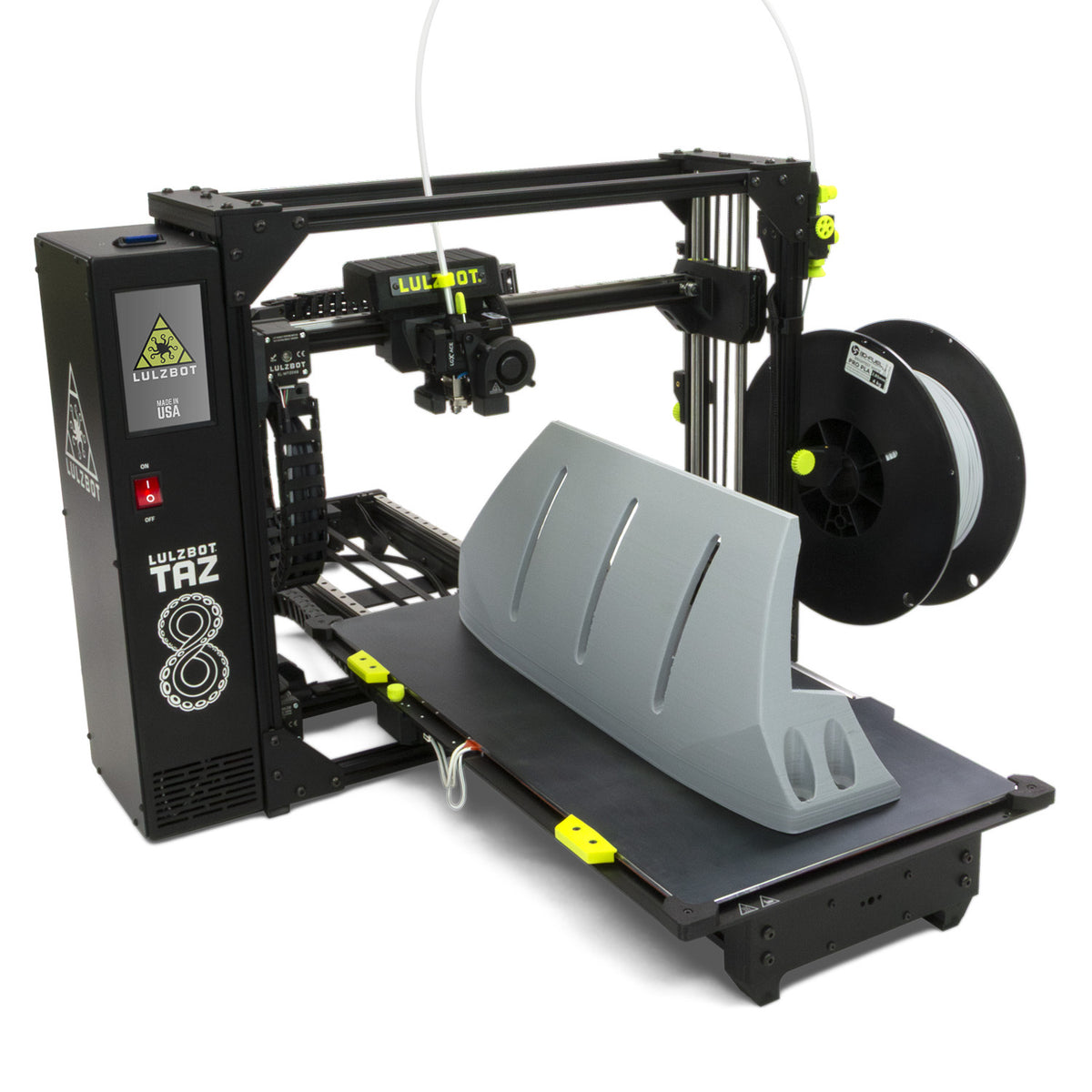
The TAZ 8 Long Bed is an open-frame professional FFF printer built around an unusually long 295 x 582 x 285 mm work envelope. LulzBot pairs that bed with linear rails on X and Y, independent geared Z drives, 32-point BLTouch meshing, automatic X-axis tramming, a magnetic flex plate, filament runout and stripping detection, and conventional Marlin firmware. It prints from USB serial or the included SD card rather than centering the workflow on a cloud account.
The standard configuration is deliberately oriented toward throughput and large functional geometry. Its Asteroid 285 tool head uses 2.85 mm filament and a 1.2 mm GammaMaster steel nozzle, with a stated 0.3 to 0.9 mm equipped layer-height range. That is a very different job profile from miniature, fine-detail, or decorative desktop printing.
Who should buy it, and who should skip it
Best fit: university labs, government or restricted-network facilities, existing LulzBot fleets, and professional shops producing long jigs, fixtures, patterns, ducts, housings, or prototypes that would otherwise need splitting and joining. Its strongest case is not generic large-format printing; it is eliminating seams or assembly labor on a recurring, measured workload.
Skip it: buyers whose parts fit a normal 250 to 350 mm machine, anyone expecting an enclosed engineering-polymer platform out of the box, teams that need camera-based remote monitoring or modern fleet software, and users prioritizing fine surface detail from the standard tool head. A large price premium is hard to defend if the extra 297 mm of Y travel is only occasionally useful.
Key specifications in context
| Specification | What it means |
|---|---|
| 295 x 582 x 285 mm build volume | The main reason to consider it: long one-piece parts and long rows of smaller parts. The moving bed also demands substantial front-to-back clearance. |
| 1.2 mm steel nozzle; 0.3-0.9 mm equipped layers | Optimized for material flow and large geometry, not fine detail. Tool-head options must be evaluated separately for other work. |
| 290 C firmware-limited hot end | Useful temperature headroom, but material suitability also depends on the 80 C bed, open environment, drying, ventilation, and a qualified profile. |
| 80 C maximum bed temperature | A meaningful limitation compared with many enclosed professional systems, especially for large warp-prone parts. |
| 150 mm/s firmware-limited travel speed | A stated motion ceiling, not a promised print speed. The exact part, extrusion rate, material, and quality target set practical throughput. |
| 32-point mesh, automatic tramming, Z offset and backlash compensation | Helpful automation for a very long bed, although the resulting first layer still requires validation across the full surface. |
| USB serial and SD card | Simple offline operation, but no integrated camera, Ethernet, Wi-Fi, or cloud fleet layer is listed. |
| One-year standard warranty | LulzBot lists extended options; buyers should confirm coverage, service response, and freight terms in the quote. |
Strengths
A genuinely useful long axis
A 582 mm Y axis can remove joints from long fixtures, brackets, covers, ducts, costume components, and anatomical or educational models. Avoiding a bond line can reduce labor, tolerance stack-up, weak interfaces, and finishing. For batch work, the same axis can hold a long row of parts, although one failed job can also put more material and machine time at risk.
Maintenance-minded, offline architecture
The Marlin and Cura LE workflow, removable SD card, tool-free tool-head mounting, accessible open frame, and replaceable mechanical components suit organizations that value serviceability over an appliance experience. LulzBot says the printer is designed, manufactured, and supported in Fargo, North Dakota. That may matter to institutional buyers, but it should be verified through service terms rather than treated as a performance guarantee.
Automation aimed at a difficult bed
Automatic mesh leveling and X-axis tramming are more valuable on a 582 mm surface than on a small desktop plate. The magnetic flex system should simplify removal of broad parts, and the filament encoder is designed to detect both runout and stripping rather than only the absence of filament.
Limitations and operating costs
The stock tool head is specialized
A 1.2 mm nozzle can lay down thick roads quickly, but it cannot deliver the detail expected from a common 0.4 mm desktop setup. The listed 0.3 mm minimum equipped layer height reinforces that positioning. Buyers should request sample parts representing their own wall thickness, holes, text, surface finish, and tolerances before purchase.
Open-frame thermal limits
LulzBot lists materials including PLA, TPU, ABS, PETG, PVA, PVB, nylon, and PC, but a material name on a compatibility list does not guarantee successful full-bed parts. A 582 mm ABS, nylon, or polycarbonate job magnifies shrinkage, draft, bed-adhesion, moisture, fume, and thermal-gradient problems. The product page links to an optional enclosure, yet the currently linked TAZguard Long Bed enclosure page explicitly says it is not compatible with the TAZ 8 Long Bed. Confirm the exact compatible enclosure and ventilation solution in writing before planning high-temperature work.
Large moving-bed consequences
The machine moves the 582 mm bed in Y. Long prints therefore require generous clearance, stable furniture, cable clearance, and profiles appropriate for a large moving mass. The nominal volume also understates real operating space: spool access, tool changes, part removal, service work, and any future enclosure all add room.
Evidence is still thin
The exact model is currently listed by LulzBot and major retailers, but detailed independent testing is sparse. LulzBot's claims about reliability, accuracy, throughput, and cooling should be treated as manufacturer claims until the buyer validates them with representative parts. At this price, a remote demo, benchmark print, acceptance criteria, and written support plan are more useful than a generic sample benchy.
Workflow and total cost
The ,995 printer price is only the entry cost. Budget for 2.85 mm filament inventory, material drying, replacement plates and nozzles, suitable furniture, ventilation where required, power, operator training, failed large prints, and service downtime. The included kilogram of PLA is small relative to the material a full-bed part can consume.
Use total delivered part cost for the decision: slicing and setup time, print duration, material, scrap probability, post-processing, joining labor avoided, and machine utilization. If a long part is rare, outsourcing may be more economical than keeping a specialist platform idle.
Alternatives to compare
Standard LulzBot TAZ 8: our TAZ 8 review covers the same maintainability-first platform in a smaller 295 x 295 x 285 mm format at a lower starting price. It is the obvious internal comparison when most parts fit a square bed.
Prusa XL+: our Prusa XL+ review examines a large multi-tool platform with a 360 mm cube volume. It is shorter in Y but brings a very different toolchanging workflow and segmented bed.
Outsourced production: for occasional long parts, compare the true ownership cost with a quoted job. Outsourcing avoids tying up capital and shifts maintenance and failure risk to the supplier, while ownership wins when demand is frequent, sensitive, or time-critical.
Questions to put in the purchase order
- Which exact tool head, filament diameter, nozzle, and build surface are included?
- What enclosure is actually compatible with the TAZ 8 Long Bed, and what ventilation is required?
- What dimensional and first-layer acceptance test covers the full 582 mm axis?
- What are the warranty response, return-freight, loaner, parts-stock, and escalation terms?
- Can the seller print a representative customer file in the intended material before acceptance?
- Which Cura LE and firmware versions are qualified together at delivery?
Final verdict
The TAZ 8 Long Bed has a clear purpose: long one-piece functional parts on a maintainable, offline-friendly, US-supported platform. That purpose can justify the price in a lab or shop where seams and assembly are recurring costs. It is not a general best buy. The open frame, 80 C bed, coarse standard nozzle, basic connectivity, huge operating footprint, and limited independent evidence demand a workload-driven purchase and a formal acceptance test.
If the real need is finished parts rather than another machine to operate, explore JCPRINTFARM's production 3D printing service or send the project through the farm intake page. Browse the 3D printer reviews hub for more model-specific research.
Sources checked
- LulzBot TAZ 8 Long Bed official product page - exact-model specifications, price, warranty, included items, image, and availability.
- LulzBot TAZ 8 platform launch documentation - mechanical design and feature context.
- B&H exact-model listing - independent retailer cross-check of identity and core specifications.
- Ultimate 3D Printing Store exact-model listing - second retailer cross-check; its direct product URL redirected when rechecked, so it was not used as evidence of current stock.